Going green is no longer just a corporate responsibility; it is a business necessity. Businesses can achieve sustainable growth by measuring their carbon footprint, improving energy efficiency, adopting renewable energy, creating more sustainable supply chains, and embedding sustainability into corporate governance. A structured and data driven approach helps organizations reduce costs, strengthen resilience, meet stakeholder expectations, and create long term competitive advantages in a low carbon economy.
Executive Summary: The 5 Essential Steps for a Business to "Go Green"
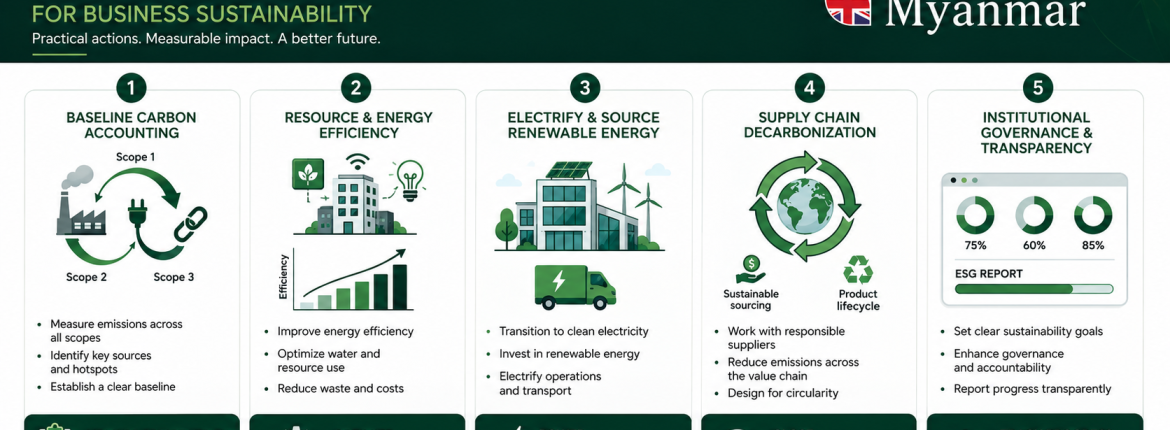
When a business transitions to a sustainable, low-carbon model, it must move away from fragmented, ad-hoc actions and follow a metric-driven, structured framework. The five crucial steps required are:
-
Establish Baseline Carbon Accounting & Auditing: Measure your actual environmental footprint across Scope 1 (direct emissions), Scope 2 (indirect energy emissions), and Scope 3 (value chain emissions) using recognized standards like the GHG Protocol or ISO 14001.
-
Optimize Resource & Energy Efficiency: Lower absolute demand by updating to smart HVAC systems, implementing high-efficiency LED industrial lighting, and retrofitting properties to prevent heat/cooling loss.
-
Electrify & Source Renewable Energy: Decouple your operations from fossil fuels by replacing conventional boilers with heat pumps, transition your fleet to Electric Vehicles (EVs), and source green electricity through certified 100% renewable tariffs or on-site solar PV arrays.
-
Supply Chain Decarbonization & Circularity: Audit your procurement and implement sustainable sourcing policies. Mandate vendor emission declarations, transition to low-embodied carbon raw materials, and redesign packaging for circularity (repairability, reuse, or recycling).
-
Formal Institutional Governance & Transparency: Set formal Science-Based Targets (SBTs), embed environmental KPIs into executive governance, implement ongoing employee training, and utilize standardized ESG frameworks to disclose progress and prevent greenwashing risks.
Going Green: A Strategic Roadmap for Corporate Sustainability
An Official Briefing Article from the British Chamber of Commerce Network
The transition to a sustainable, low-carbon economy represents one of the defining operational and strategic challenges for the private sector in the second quarter of the 21st century. Driven by strict international regulations, shifting consumer preferences, and the commercial imperative to mitigate escalating resource costs, "going green" is no longer an exercise in corporate philanthropy. Instead, it has matured into a foundational pillar of modern risk management and long-term value creation.
Data consistently highlights both the urgency and the scale of this shift. Small and Medium-sized Enterprises (SMEs) alone constitute over 95% of businesses in the UK and European ecosystems and collectively generate roughly half (43% to 53%) of all commercial greenhouse gas emissions (Mazhar, 2024). However, recent business climate assessments indicate a pronounced operational gap: while over 90% of enterprises voice intentions or make baseline pledges to minimize environmental impacts, a staggering 61% of SMEs are still not actively taking concrete structural steps toward net-zero targets (IGL, 2023). This disconnect frequently stems from a deficit in technical expertise, constrained capital, and the absence of a structured, metric-driven strategy.
1. The Necessary Operational Steps to Go Green
For an enterprise to transition from conventional operational models to a verifiably green framework, a phased, systemic architecture must be deployed. The process is broken down into five mandatory operational stages:
-
Establish Baseline Carbon Accounting & Auditing: A business cannot manage what it does not measure. The foundational step involves executing a rigorous greenhouse gas (GHG) inventory across Scope 1 (direct emissions from owned or controlled sources), Scope 2 (indirect emissions from the generation of purchased electricity, heating, and cooling), and ultimately Scope 3 (all indirect emissions that occur in the value chain). Historical data indicates that fewer than 10% of small and medium businesses have evaluated their carbon footprint using authentic data-driven systems within the past five years (IGL, 2023). Utilizing recognized assessment standards, such as the GHG Protocol or ISO 14001 frameworks, provides the definitive benchmark needed to identify emissions hot spots and design targeted interventions.
-
Optimize Resource & Energy Efficiency: The most cost-effective carbon mitigation strategy is reducing consumption at the source. This demands deep-dive retrofitting of corporate real estate and manufacturing environments. Initial interventions focus on immediate wins: switching commercial facilities entirely to LED lighting, optimizing heating, ventilation, and air conditioning (HVAC) systems via smart automation, and upgrading legacy machinery to high-efficiency variants. Operational efficiency can be modeled through standard resource optimization formulas, ensuring that the reduction in total energy demand directly correlates with lower operational expenditures.
-
Electrification & Sourcing Renewable Energy: To systematically decouple business growth from fossil fuel reliance, companies must transition their energy procurement. This involves migrating facility heating from fossil-fuel boilers to highly efficient heat pump technologies, which leverage ambient thermal energy powered by clean electricity (Hampton, 2024). Concurrently, corporate vehicle fleets must undergo electrification. On the supply side, businesses should transition to certified 100% renewable energy tariffs or, where commercially viable, become "prosumers" by installing on-site distributed generation infrastructure, such as commercial rooftop solar photovoltaic (PV) arrays coupled with localized battery energy storage systems (BESS).
-
Supply Chain Decarbonization & Circularity: Upstream and downstream value chains typically hold the vast majority of an enterprise's total carbon impact. Going green requires auditing procurement pipelines and implementing a sustainable sourcing policy. This means mandating that vendors declare their carbon credentials, favoring raw materials with low embodied carbon, and systematically eliminating single-use plastics and excessive logistics footprints. Transitioning toward a circular economic model—where products are explicitly engineered for longevity, repairability, and end-of-life recycling—dramatically lowers the net environmental tax of corporate output.
-
Formal Institutional Governance & Transparency: The final step requires embedding sustainability into formal corporate governance. This entails setting legally binding or board-verified science-based targets (SBTs) aligned with a net-zero trajectory. Progress must be reported through transparent, standardized ESG (Environmental, Social, and Governance) disclosure protocols to prevent "greenwashing." Training programs should also be instituted to align staff across all organizational tiers, ensuring that green initiatives are actively executed on the ground rather than remaining confined to corporate policy documents.
2. Commercial Impediments and the Path Forward
While the strategic advantages of transitioning to a low-carbon model are vast—including enhanced brand equity, lower resource costs, and mitigation of regulatory risks—businesses face persistent bottlenecks. Primary among these are steep up-front capital requirements for clean technologies, short-term commercial lease constraints that disincentivize long-term facility retrofitting, and fragmented policy frameworks (Hampton, 2024).
To overcome these hurdles, business networks like the Chambers of Commerce emphasize the necessity of public-private synergy. Businesses must actively leverage emerging green finance instruments, localized grant mechanisms, and shared-ownership models to spread capital risks. By deploying structured learning and metric-driven operational frameworks, the global business community can transform climate liabilities into long-term competitive advantages.
Academic & Institutional References
-
Hampton, S. (2024). Multiple roles of business for climate action. PMC - National Institutes of Health, 1-14.
Read Source Paper -
IGL, J. P. (2023). Net zero and productivity in SMEs: overlaps and evidence needs report. Nesta / British Chambers of Commerce Research Insights, 8-15.
Read Official Report -
Mazhar, M. U. (2024). Small and medium-sized enterprises: Hard to reach, data-poor but rich in creative potential as agents of change for decarbonisation. Nottingham Trent University Institutional Repository (IRep), 1-12.
Read Institutional Repository